
Case study — Food & beverage — Original · 25 min read · 5 questions
Why everyone wants to open a bar but almost nobody survives
By Yishan Lin · Aired · Published
The thesis
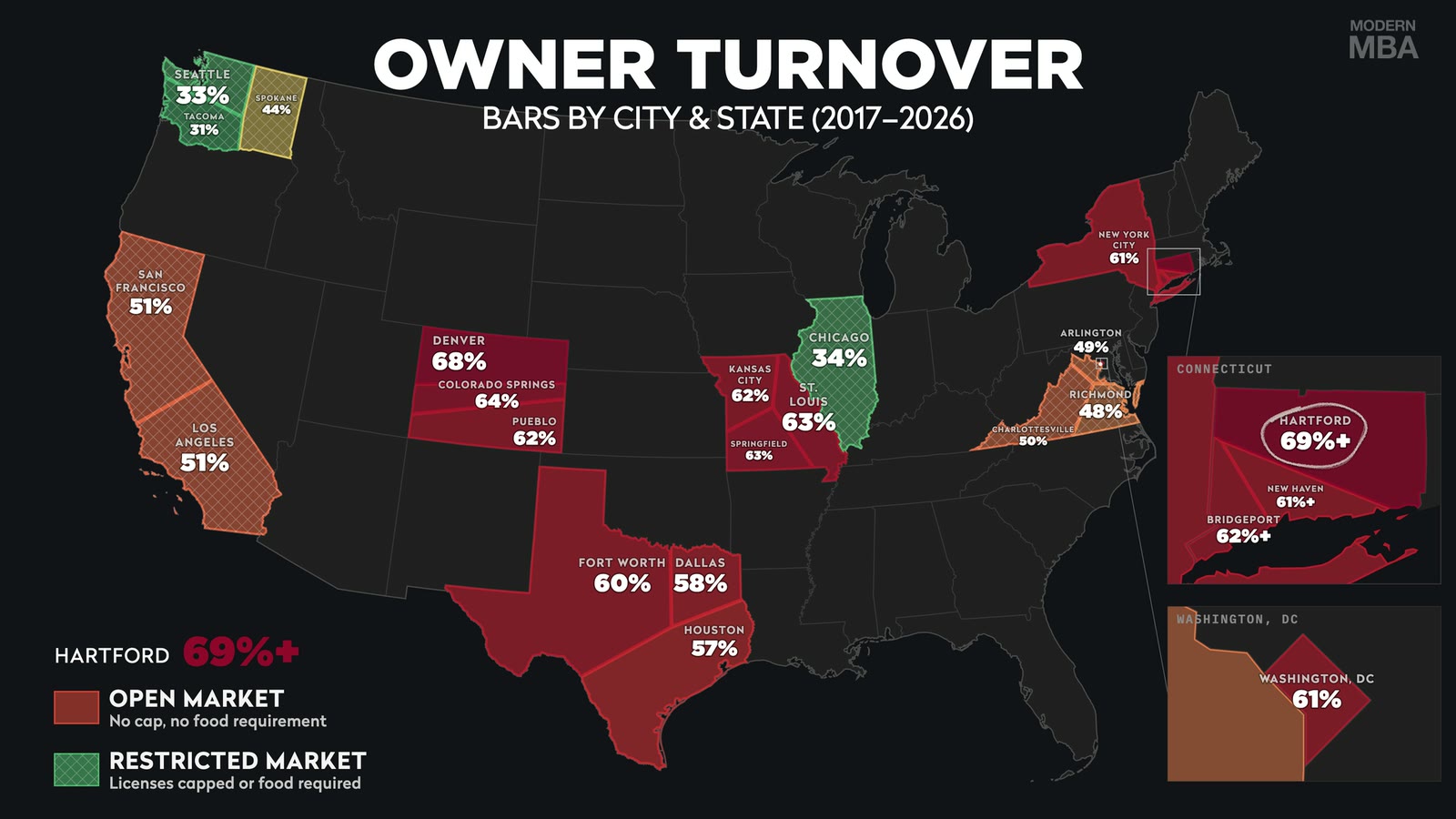
Anyone who has paid $6 for a can of beer that costs a dollar at the supermarket has done the napkin math and wondered why everyone doesn't open a bar. The pour takes a minute and keeps 80 to 90 cents of the dollar. Yet in Manhattan and Brooklyn about half the bars licensed in 2017 have closed, and about two in three have lost the owner who opened them. Texas, Denver, St. Louis and Connecticut are no kinder.
The markup is real, but the drink behind it is the same one sitting in your fridge. Since home fridges, cheap cans and Prohibition moved beer off the tap, every bar has had to sell a reason to come out. The chains bought theirs: sports on TV, wings, Hooters girls, arcade games, house-brewed IPAs, $20 cocktails. Anything a chain can buy, its rivals can buy too, so each of those reasons spread fast and went stale just as fast, and the chains that survived did it by turning into restaurants.
What keeps a bar open is the part no one can purchase: the regulars, the person behind the bar, a room people return to out of habit. Joe has run his Chelsea dive at a profit for 34 years on almost nothing else. Lullaby does everything right and clears 10%. The Rockwell Place survived only because its founders gave it to the manager who already ran it, and Death & Co, the most famous cocktail bar in New York, has lost money in every year it has tried to copy itself.
How do you think about this? 5 strategy questions this case raises and does not answer.
Answer them below
By the numbers — swipe or use arrows
Bar closures and owner changes from liquor license records of the NY State Liquor Authority, Texas Alcoholic Beverage Commission, Missouri Division of Alcohol & Tobacco Control, Connecticut Dept of Consumer Protection, California Dept of Alcoholic Beverage Control, Chicago Business Affairs and Washington State Liquor Board, 2017 to 2026; beer packaging from the Brewers Almanac (1934–1960) and the Beer Institute (2019–2025); sales per store, alcohol share and store counts from the franchise disclosure documents of Buffalo Wild Wings, Hooters, Twin Peaks, TGI Fridays, Chili's and Applebee's, and from company filings; Wingstop from its 10-K; share of Americans who drink from Gallup; alcohol sales by type from the Distilled Spirits Council; Chelsea rents from StreetEasy and the NYC Housing and Vacancy Survey; Death & Co from its filings with the SEC; US alcohol volume from IWSR; OneStar, Lullaby and The Rockwell Place from interviews with their owners
© Modern MBA. Quote and cite with credit and a link; republishing needs permission.
Animations — swipe or use arrows


Key takeaways
The napkin math is right about the markup. A can of beer that costs a little over a dollar at the supermarket sells for $6 at the bar. A $40 handle of vodka poured as $15 shots comes to about $600. The bartender opens a can or tips a bottle, the whole sale takes under a minute, and 80 to 90 cents of each dollar is gross profit. The license records tell the rest. Of the bars licensed in 2017, 52% of Manhattan's have closed and 66% have lost their original owner. Brooklyn is at 53% and 69%, Dallas at 49% and 58%, Kansas City at 51% and 62%.
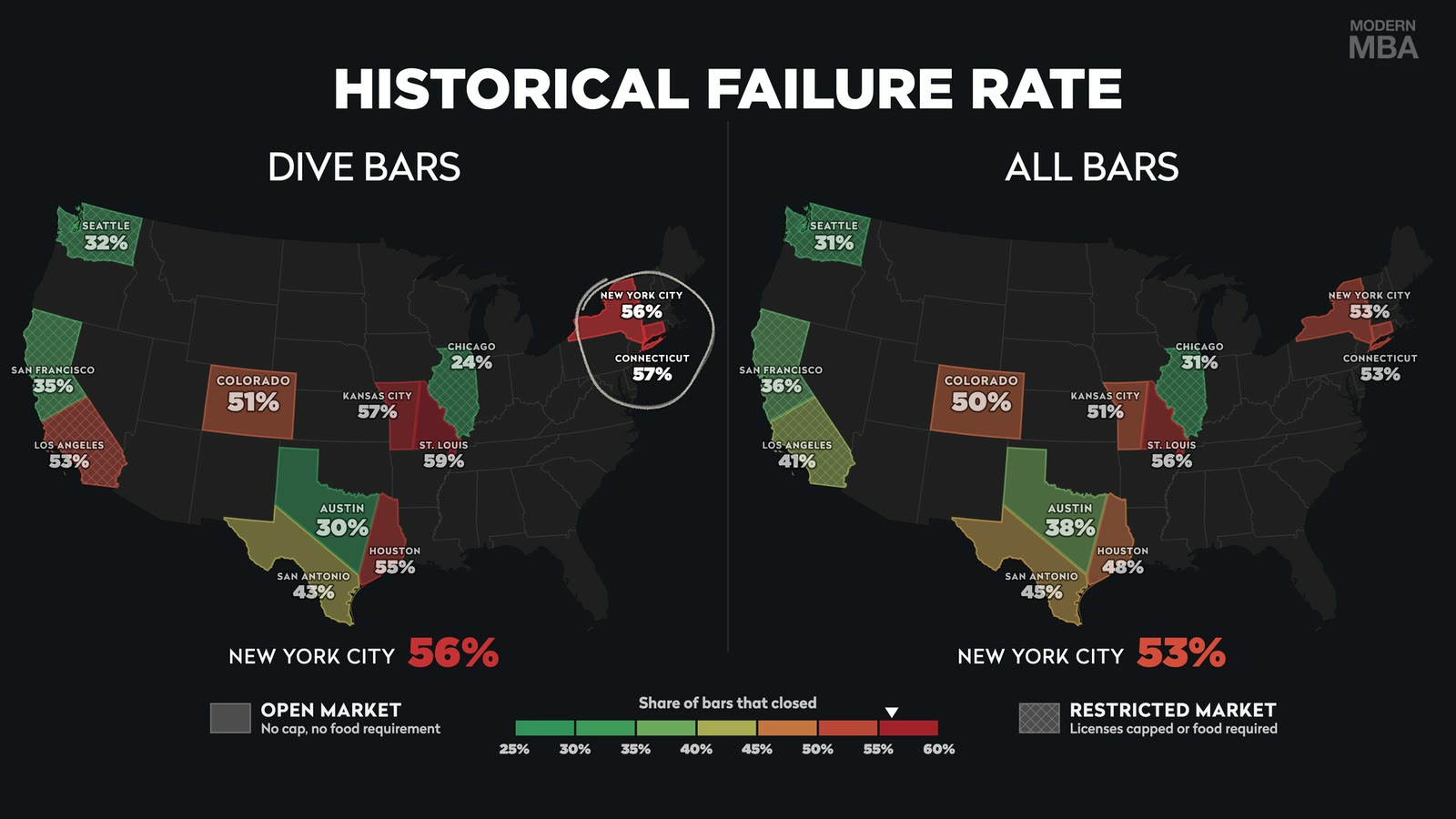
A cap on licenses saves the bar and still loses the founder. Where anyone with a lease can get a liquor license, as in New York and Texas, survival is a coin toss. Chicago limits tavern licenses by neighborhood and won't let them be sold, and only 31% of its bars closed. Seattle's figure is 31% as well. California caps licenses but lets them change hands, so Los Angeles lost 41% of its bars and 51% of its original owners: competition arrives later and costs more, but it arrives.
Since 1940, drinking out has needed an excuse. Before Prohibition almost all beer came from a tap, because nobody owned a refrigerator and glass was dear. Prohibition, then cheap cans, six-packs and home fridges, made the couch the cheapest seat. Draft was 75% of beer volume in 1934, 48% by 1940, 19% by 1960 and 10% in 2025. A bar pours the same brands the liquor store stocks and can never undercut it on price, so all it can sell is a reason to drink there.
The sports bar rents its reason from ESPN. The wall of screens, the game, the wings and the uniforms can all be ordered, installed and copied, which is why this is the one bar format that ever passed a thousand locations under one name. Buffalo Wild Wings went from 652 locations in 2009 to 1,240 in 2017. Its average store grew from $1.25 million in 2002 to $3.29 million in 2023, yet after inflation it peaked in 2014 at $3.89 million, and drinks fell from 33% of sales to 20%. Lunch and wings did the growing.
Take the bar out and the restaurant earns more. Wingstop sells the same wings without the TVs, the bartenders or the liquor license. In 2023 an average Buffalo Wild Wings took in $3.29 million to Wingstop's $1.82 million, but Wingstop kept 24.8% at the restaurant level against 18.6%. Since then the chain has added close to 200 takeout shops that serve no alcohol, while dozens of its older sports bars have shut. The bar stays in the existing stores only because it can't be ripped out.
Hooters and Twin Peaks bought one more reason, and it wore out too. Both made every franchise keep a full bar for the life of the store. Alcohol at Hooters stuck at about 27% of sales, inflation-adjusted sales per store went from $2.9 million in 2011 to $3.0 million in 2022, and the chain fell from 386 locations in 2009 to 194 by way of bankruptcy. Twin Peaks kept the bar at the center, about 47% of every dollar, and its stores grossed $5.53 million in 2022, the most in the category. But each one cost about a year's sales to build and only worked in Sunbelt suburbs, so it reached 115 locations, and the debt it took on to grow faster sank it.
The bar and grill was a bar the suburbs made cook. After Prohibition most towns zoned out stand-alone taverns, and most states would not license a bar without a kitchen. Fridays, Chili's and Applebee's all put "bar" in their names to fill that gap, growing from 40, 15 and 1 locations in 1980 to 820, 979 and 1,671 by 2004. Then happy-hour bans and dram-shop liability capped what the bar could earn, while the kitchen faced no such limits and sold to everyone, so food became the business.
The chains that leaned hardest into food are the ones still standing. Fridays, born in 1965 as a singles bar on First Avenue, kept pushing the bar as the draw; it went from 468 locations in 2016 to 80 in 2025, with a bankruptcy in 2024. Chili's let alcohol slide from 11.4% of sales to 9.0% between 2019 and 2025 while its average store went from $2.64 million in 2015 to $4.76 million. Its sweet $6 margaritas are an add-on for people who came for the burger. Applebee's kept the bar and a weaker menu, and fell from 1,870 stores in 2014 to 1,507 in 2024, its inflation-adjusted sales per store from $3.3 million to $2.6 million.
Games and house beer sold the same way and spoiled the same way. At Dave & Buster's alcohol is 30% of food and beverage sales; the games fill the room and the bar holds the margin. Any of that equipment can be bought, so Topgolf lost value as Drive Shack and Puttshack copied it. The brewpubs had IPAs when craft was 2% of American beer. Once every chain had a tap wall and Whole Foods stocked the same beer, most of them went bankrupt: Gordon Biersch went from 29 locations in 2010 to 1 in 2026, Rock Bottom from 30 to 6. BJ's lived by becoming a pizza restaurant, with 219 locations in 2025 and alcohol down from 23% of sales to 17%.
New York invents the reasons, and its bars die fastest. The singles bar that became Fridays opened there, and so did the craft cocktail at Milk & Honey in 1999, the arcade bar and bottle service. Of the bars open in 2017, 52% in Manhattan and 53% in Brooklyn are gone, and 66% and 69% have lost their original owners. Run those rates back to 1992 and 93% of the bars open then have closed.
OneStar survives by giving no reason at all. Joe opened his first Chelsea bar in 1992 and OneStar in 2013: no kitchen, no cocktail list, no theme, never more than two people working, and a profit every year. "Food is where you lose your money," he says. Simple is not safe, though. In New York 50% of full-liquor dives and 62% of beer-and-wine dives have failed, while Chicago's cap holds dive failures to 24%. In Chelsea 59% of bars are gone as median rent climbed from $1,050 in 1996 to $5,993 in 2026, and Barcade opened across the street.
What is shrinking OneStar can't be fixed from behind the bar. Rents pushed young people out of the neighborhood, and remote work emptied the offices that fed happy hour. "This used to be three bartenders on happy hour. Not anymore," Joe says. Americans are drinking less, too: 54% tell Gallup they drink, the lowest since it first asked in 1939, and IWSR counts a 5% fall in US alcohol volume in 2025. At a chain alcohol is 20 to 30% of the check, while at OneStar it is the whole check. Sales went from $80,000 a month to $40,000, and the margin from 50% in the 1990s to 23% in the 2010s and 18% now. "I feel like the only thing I'm good at right now is not losing money," Joe says.
The cocktail bar charges the most and fails the most. Spirits passed beer in US supplier revenue in 2022, 42.1% to 41.9%, and a cocktail is the furthest a bar can get from the store shelf. At $20 a drink, Lullaby earns from one cocktail what OneStar earns from four beers over a night. Even so, 57% of New York's cocktail bars have failed, worse than any type but the beer-and-wine dive, and Texas loses 62% of its cocktail bars within seven years. The format needs a costly room, skilled staff and rich neighbors, one bartender can only make so many drinks, spirits stopped growing in 2023, and canned cocktails and restaurant menus now offer the same thing.
Lullaby does everything right and makes 10%. Harrison and Jake, both in their twenties, run it closer to a club: lights tuned by hand, vinyl that changes by the hour, a bouncer who keeps the room from overfilling, and $5 beers and $8 shots beside $20 cocktails. Bartenders earn a royalty on any drink of theirs that makes the menu. "It shouldn't be a puzzle. It should just be delicious," Harrison says. Lullaby takes in $95,000 a month, $1.14 million a year, at a 10% operating margin that Harrison says was like pulling teeth to reach, split between two owners and their investors.
The Rockwell Place lived by turning into a neighborhood bar. Toby Cecchini, who invented the Cosmopolitan, and Joel Tompkins opened it in 2018, a mile from their acclaimed Long Island Bar, expecting their regulars to follow. They didn't come, and the Rockwell sits alone on a block with nothing else to draw a passerby. Alex, who rose from barback to manager, traded the small plates for burgers and cut a 30-page cocktail book down to the drinks people kept ordering, and last year the founders gave him the bar rather than close it. Around BAM, 77% of bars have lost their original owners. Alex's Rockwell takes in roughly $997,000 a year, about $83,000 a month; food is under 15% of it, and after paying himself he keeps 9.3%.
Death & Co is the proof that the room doesn't travel. It is the most famous bar of the New York cocktail revival, and its owners took it to Denver, Los Angeles and Washington with a hotel, merchandise and an app, financed by selling shares to the public. Revenue rose from $7.39 million in 2019 to $15.4 million in 2025, and it lost money in every one of those years, $3.65 million in the last. Its cocktails carry a 78% gross margin, but labor takes 55 to 65% of sales. It now stays afloat by selling stock, borrowing from its founders and taking advances on the card receipts of three of its four bars, and it has given up on expansion.
Discussion
- Question 1 of 5
A can of beer sells for six times its store price and most bars still close within a decade. Where does the markup actually go, and what would you cut first if you ran one?
Viewer perspectives
Be the first to share your perspective.
- Question 2 of 5
Chicago's cap on tavern licenses keeps more bars open but makes a license nearly impossible to get. Is a capped market better for drinkers and owners, or does it only protect whoever got in first?
Viewer perspectives
Be the first to share your perspective.
- Question 3 of 5
Buffalo Wild Wings, Chili's and BJ's grew by turning bars into restaurants. Is a bar that sells mostly food still a bar, and does that matter to the customer?
Viewer perspectives
Be the first to share your perspective.
- Question 4 of 5
Lullaby does everything a modern bar is supposed to do and earns about 10%. Would you put your own money into a bar at that margin, and what would make it worth it?
Viewer perspectives
Be the first to share your perspective.
- Question 5 of 5
Death & Co couldn't make money copying its famous room in other cities. Is there any bar format that could scale without losing what made the original worth visiting?
Viewer perspectives
Be the first to share your perspective.
Don’t let an algorithm decide what you get to see.
Get an email the moment a new episode drops, with commentary that never made the final cut.
Common questions
How much profit does a bar make on a drink?
On the pour itself, a lot. A can that costs a little over a dollar at retail sells for about $6, and a $40 handle of vodka poured as $15 shots brings in about $600, so 80 to 90 cents of each dollar is gross profit. Rent, labor and everything else come out of that. The three New York bars in this case ran operating margins of 18% (OneStar, a dive), 10% (Lullaby, a cocktail bar) and 9.3% (The Rockwell Place, after the owner's salary).
How much money does a bar make in a year?
Less than the markup suggests. The three New York bars in this case shared their numbers. OneStar, a dive in Chelsea, grosses about $40,000 a month, or $480,000 a year, half what it took in during the 2010s, and keeps 18%. Lullaby, an East Village cocktail bar, takes in $95,000 a month, $1.14 million a year, at a 10% operating margin. The Rockwell Place in Brooklyn does about $997,000 a year and keeps 9.3% once its owner has paid himself. The biggest of them grosses about a third of an average Buffalo Wild Wings.
What percentage of bars fail?
Liquor license records show that roughly half of New York's 2017 bars have since shut, 52% in Manhattan and 53% in Brooklyn, and about two in three have lost their original owner. Dallas and Kansas City are close behind. Where licenses are capped, bars last longer: in Chicago and Seattle 31% closed. A cap protects the bar more than its owner, though, and in Los Angeles more than half lost their original owners.
What type of bar is most likely to fail?
In New York, a dive that sells only beer and wine: 62% of those open in 2017 have closed. Cocktail bars come next at 57%, then wine bars at 55% and sports bars at 53%. Full-liquor dives did a little better at 50%, and nightclubs and entertainment bars best of all, at 42% and 40%. Even the safest category loses two in five. Cocktail bars fare badly outside New York too: Texas loses 62% of its cocktail bars within seven years, faster than any other state.
Do liquor license limits help bars survive?
They help the bar more than the person who opened it. Chicago caps tavern licenses neighborhood by neighborhood and forbids selling them, so a license keeps rivals off the block: 31% of its bars closed, and only 24% of its dives. California caps licenses too but lets owners sell them, so rivals still arrive, just later and at a higher price. Los Angeles lost 41% of its bars and 51% of its original owners. New York and Texas grant a license to anyone with a lease, and roughly half their bars are gone.
Why do bars fail even though drinks have such a high markup?
A bar stocks the brands any grocery store carries. Its real product is whatever gets people off the couch, which costs a lot to build and is easy to lose. Sports, wings, games, craft beer and fancy cocktails can all be bought, so competitors copy them and they stop being special. Regulars, a good owner and a room people come back to can't be bought, take years to build, and are what keep the survivors open.
Why do Americans drink at home instead of at bars?
Because it has been cheaper and easier for almost a century. Before Prohibition few homes had a refrigerator and bottles were expensive, so beer came from a saloon's tap. Prohibition, affordable cans, the six-pack and the home fridge changed that, and by 1940 packaged beer outsold draft. Draft fell from 75% of beer volume in 1934 to 19% by 1960 and 10% in 2025. From the 1980s on, a drinking age of 21, tougher drunk-driving laws and dram-shop liability made the bar's extra rounds harder to sell, while the couch faced none of those rules.
Are Americans drinking less alcohol?
Yes. Only 54% of Americans told Gallup they drink in 2026, down from 71% in 1978 and the lowest share since the poll began in 1939. Volume across beer and spirits has fallen four years running, and IWSR measured a 5% drop in 2025. Nobody agrees on the cause; the economy, health, cannabis and Ozempic all get blamed. A chain barely notices, since alcohol is only 20 to 30% of its check. At a bar like OneStar, where drinks are the whole check, every lost round comes straight out of sales.
Why don't dive bars serve food?
Because a kitchen costs more than it earns them. "Food is where you lose your money," says Joe, who has run OneStar in Chelsea at a profit every year. Without food there is no cook to pay and nothing in stock that spoils, so his only big costs are liquor, rent and the one or two people behind the bar, and nothing on the menu takes long to pour. A small bar also has no room to add a kitchen later, which leaves an independent dive with nothing but the drinks.
Is Buffalo Wild Wings a bar or a restaurant?
Increasingly a restaurant. Drinks fell from 33% of its sales in 2002 to 20%, and the growth in its stores came from wings and lunch. Wingstop, which sells the same food with no bar, runs a better margin at about half the sales per store. Buffalo Wild Wings has opened nearly 200 takeout-only stores with no alcohol or TVs and has been closing older sports bars.
What happened to Hooters and Twin Peaks?
Both added one more draw to the sports bar, the waitresses, and both required every franchise to keep a full bar for the life of the store. At Hooters alcohol stalled at about 27% of sales, the novelty and the food both wore thin, and the chain fell from 386 locations in 2009 to 194 after a bankruptcy. Twin Peaks kept alcohol near half of sales and its stores grossed $5.53 million in 2022, the most in the category, but each new one cost about a year's sales to build. It reached 115 locations, and the debt it took on to grow faster brought it down.
Why did TGI Fridays go bankrupt?
Fridays started in 1965 as a singles bar on First Avenue in Manhattan and grew as a suburban bar and grill, but it kept selling the bar as its main draw after the suburbs filled up with better options. It went from 468 locations in 2016 to 80 in 2025 and filed for bankruptcy in 2024. Chili's, which let alcohol shrink to 9% of sales and leaned on food, has the best sales per store in its history.
Why is Chili's doing well while Applebee's shrinks?
Chili's stopped relying on its bar. Alcohol fell from 11.4% of its sales in 2019 to 9.0% in 2025, while the average store's sales rose from $2.64 million in 2015 to a record $4.76 million. Its drinks, like the $6 margarita, are something to add to a burger. Applebee's has a weaker menu and still needs the bar's margin to keep its franchisees, so it held on to it. Its store count fell from 1,870 in 2014 to 1,507 in 2024, and inflation-adjusted sales per store went from $3.3 million to $2.6 million.
What happened to brewpub chains like Gordon Biersch and Rock Bottom?
They lost the one thing they had. In the mid-1990s craft was 2% of American beer and a brewpub was about the only place to get an IPA. By 2019 every chain restaurant had a tap wall and grocery stores like Whole Foods stocked the same beers, and most of the big chains went bankrupt. Gordon Biersch went from 29 locations in 2010 to 1 in 2026, Rock Bottom from 30 to 6. BJ's survived by becoming a pizza restaurant: it has 219 locations, no longer brews most of its own beer, and alcohol has fallen from 23% of its sales to 17%.
Where did the modern cocktail bar start?
In New York. Alex, who now owns The Rockwell Place, traces it to Dale DeGroff at the Rainbow Room, who went back to fresh juice when most bars had switched to sour mix, then mentored Julie Reiner and Sasha Petraske of Milk & Honey. Milk & Honey, an unmarked Lower East Side room with no menu, opened in 1999 and set off both the craft cocktail movement and the hidden speakeasy. A decade later the format had spread across the country, and today every one of the fifty entries on the World's Best Bars list is a cocktail bar.
Why are cocktail bars so hard to run?
They need a room that looks the part, skilled and well-paid bartenders and a neighborhood that can afford $20 drinks, and each drink takes time, so a bartender serves fewer people. In New York 57% of cocktail bars open in 2017 have closed, more than any type except beer-and-wine dives, and in Texas 62% close within seven years. Restaurants now serve cocktails too, and canned cocktails sell the same drinks for home.
Does Death & Co make money?
Not as a company. Death & Co sold shares to the public to open bars in Denver, Los Angeles and Washington, so its books are filed with the SEC, and they show an operating loss every year from 2019 to 2025 even as revenue doubled to $15.4 million. Its cocktails are very profitable on their own, but labor takes 55 to 65% of sales, and it now relies on equity sales, founder loans and cash advances against card sales.
Is opening a bar worth it?
For most people, only if they love running it. About half of New York's bars close within nine years, and the ones that survive keep little. Lullaby does nearly everything right, grosses $1.14 million and earns 10%, which its two owners split with their investors; Harrison says only nightclubs and hospitality groups that share costs reach 15% or more. OneStar's owner, Joe, has been profitable for 34 years and now says, "I feel like the only thing I'm good at right now is not losing money." The markup pays for the room and the regulars, and those take years to build.
Related case studies
 Food & beverageHow much a Texas BBQ joint actually makesOne in three fail, brisket yields 40%, and the biggest variable in whether you survive is one magazine editor's palate.16 min read
 Food & beverageWhy buffets went extinctThe buffet did not lose to a better restaurant. It lost to the deli counter twenty feet away, and to its own cost structure.16 min read
 Food & beverageWhy fast food can't make a good burgerMcDonald's makes more from rent than from food. That is why it can't fix the burger — and why four LA independents can.13 min read